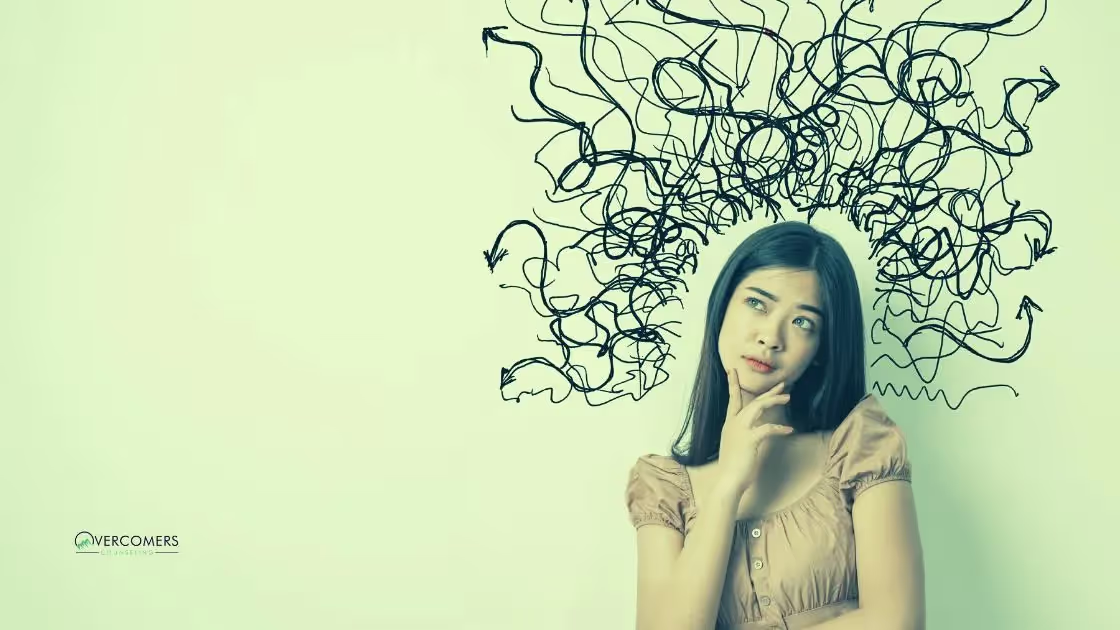
Melancholic Depression is also known as Melancholia is a type of major depressive disorder (MDD) characterized by sadness.This type of depression is more...


Melancholic Depression is also known as Melancholia is a type of major depressive disorder (MDD) characterized by sadness.
This type of depression is more common in middle-aged and older adults than in children and adolescents.
This disorder affects many areas of life.
People with major depressive disorder frequently lose interest in previously appreciated activities.
They struggle to get through the day, with this kind of depression there is a complete loss of pleasure in almost everything.
Statistics show that this form of depression affects 15% to 30% of people with depression. Although this kind of depression was once considered a unique mental condition, the American Psychiatric Association (APA) no longer recognizes it as such.
Instead, melancholia is now thought to be a distinguishing feature of major depressive disorder (MDD), a subtype of major depressive illness.
Melancholic depression is a result of changes in your brain and hormonal pathways. It is a genetic condition, often associated with a family history of mood disorders or suicide. In comparison to other depression subtypes, social and psychological factors rarely play a role in melancholic depression.
A person suffering from melancholy may have fewer neurons connecting to their insular (the part of the brain responsible for attention). It is a situation when the hypothalamus, adrenal glands, and pituitary glands are not functioning correctly as they should, these changes can have an impact on a person's appetite stress levels, and other factors.
Psychomotor slowness, pervasively sad mood, lack of response, and loss of interest are key characteristics. They distinguish melancholic depression from non-melancholic depression.
In this distinction, psychomotor retardation and delusional symptoms are cardinal symptoms.
Melancholic depression can lead to high-level production of Cortisol, which is a steroid hormone released by the adrenal glands when you are under stress. This, in turn, affects the proper function of your brain, metabolism, body, and appetite.

People with Melancholic Depression tend to show the typical major depressive disorder (MDD) symptoms, while others develop additional syndromes including melancholia or catatonia.
Symptoms and signs of Melancholic depression tend to be worse in the morning, when there is less sunlight, on shorter days and when the temperature is low.

Melancholic Depression is treated in different ways, it involves a combination of meditation and therapy.
Treatment, which may include medication and talk therapy, can help with the majority of symptoms.
Melancholia is often better treated with older medications (MAOIs and TCAs) than with newer ones (SSRIs). The older medications, on the other hand, have a high number of adverse effects. Individuals who require medication should consult with a mental health practitioner to discuss the benefits and drawbacks of each drug.
Psychiatrists can prescribe antidepressants such as.
Therapy is commonly employed in conjunction with medicine to treat melancholia. In most cases, combining these two therapy modalities is more beneficial than each approach alone.
Physiotherapy or talk therapy is regular meetings with a therapist to discuss symptoms and related difficulties. With physiotherapy, a person would learn to recognize when their guilt or shame is out of control. They can learn to challenge negative thinking with more balanced viewpoints with effort.
Physiotherapy or talk therapy can help show one how to:
Group therapy may also benefit someone with melancholic depression. A person can talk with others who have the same problem in group therapy. Group therapy can provide emotional support to someone who has separated themselves due to depression.
In some cases to assist reduce symptoms of MDD with melancholy aspects, Electroconvulsive Therapy (ECT) may be used. In severe cases of depression that have failed to respond to previous therapies, doctors may utilize electroconvulsive therapy (ECT).
They may also utilize electroconvulsive therapy (ECT) on seniors who have had a negative reaction to medicines. ECT is now a lot safer than it was previously due to modern studies. However, because of the possibility of memory-related side effects, many experts only prescribe it as a last resort.
According to Mental Health America, a technique known as Cranial Electrotherapy Stimulation (CES) may one day take the role of ECT. Unlike ECT, CES can be performed without the assistance of a doctor.
However, for major depression disorder (MDD) with melancholic depression, a combination of medication, talk therapy, and ECT may be the most effective treatment.
Alternative treatments, such as acupuncture, may be used by someone suffering from melancholic depression.
Because melancholic depression is marked by deep emotions of melancholy, loss of pleasure, and a lack of interest or pleasure in activities, it can have a significant impact on a person's ability to operate in so many areas of life.
If you feel you could be suffering from melancholic depression, you will need to go see a doctor.
https://www.healthline.com/health/depression/melancholic-depression
Therapy can help with many types of depression, including major depressive disorder, persistent depressive disorder (dysthymia), seasonal affective disorder, postpartum depression, and depression related to life transitions or grief. Your therapist will tailor treatment to your specific needs.
What is the goal of depression counseling?
Living with depression can feel like walking through thick fog every day, where the world looks muted and it’s hard to find your way. The goal of counseling isn’t to instantly make the fog disappear. It’s to give you a powerful flashlight so you can find your path again. Depression counseling helps you better understand your symptoms of depression, identify what’s contributing to them, and learn healthier ways of coping.
We work together to help you understand what's behind the fog, rediscover your sense of purpose, and rebuild your life, one step at a time. We believe in your capacity to feel joy again.
How can counseling help me get my life back?
When you're dealing with depression, even the smallest tasks can feel like climbing a mountain. Counseling helps you build the skills and stamina to make that climb. Through evidence-based approaches such as cognitive behavioral therapy (CBT), we help challenge unhelpful thought patterns and behaviors that reinforce depression.
We'll help you challenge the negative thought patterns that weigh you down and find ways to re-engage with your life. Treating depression is not about perfection; it’s about progress and learning how to support yourself with compassion.
Can therapy really help with depression?
Yes! Therapy is one of the most effective ways to treat depression. Research consistently shows that depression therapy—especially CBT—is effective for depression, including major depressive disorder and persistent depressive disorder.
We'll help you navigate the difficult emotions and challenge the unhelpful beliefs that are holding you back. You are not alone in this fight, and we'll be there to support you every step of the way.
What if I don't feel motivated to go to counseling?
We get it. Depression often drains motivation, energy, and hope. A lack of motivation is itself a common symptom of depression—not a failure. You don’t have to feel “ready” to start. Just showing up is enough. We’ll meet you where you are and move at a pace that feels manageable.