Have you recently noticed some emotional ups and downs? Perhaps you often feel depressed and can't quite understand why? After visiting your doctor, you...

Have you recently noticed some emotional ups and downs? Perhaps you often feel depressed and can't quite understand why? After visiting your doctor, you were diagnosed with bipolar affective disorder? Don't worry, we've got you covered. After reading this post, you'll learn about bipolar affective disorder, the causes of your recent mood swings, and the proper steps needed to manage your depression, including bipolar disorder symptoms, the concept of a major depressive episode, and anxiety disorders. Mental disorders, mood disorders, and other related disorders can be helped. You'll also get some ideas on how to manage your depression.
Let's get started.
Definition
Bipolar Disorder (Bipolar I) involves full manic episodes, whereas Bipolar Affective Disorder (Bipolar II) involves hypomanic episodes, which are less severe.
Symptoms of Bipolar Disorder
Common symptoms include manic or hypomanic episodes, major depressive episodes, and shifts in mood and behavior.
Types of Bipolar Disorder
There are four types: Bipolar I, Bipolar II, Cyclothymic Disorder, and Other Types caused by substances like alcohol or drugs.
Symptoms of Mania
Increased energy, emotional behavior, rapid talking, sociability, racing thoughts, high self-esteem, and distractibility.
Impact on Life
Affects work, behavior, and relationships. People with bipolar disorder often struggle with maintaining stability in daily life.
Treatment
Both medical and psychological treatments are essential for managing symptoms and maintaining a balanced life.
Misconceptions
Bipolar disorders are mental health conditions, not spiritual problems, requiring appropriate medical treatment.
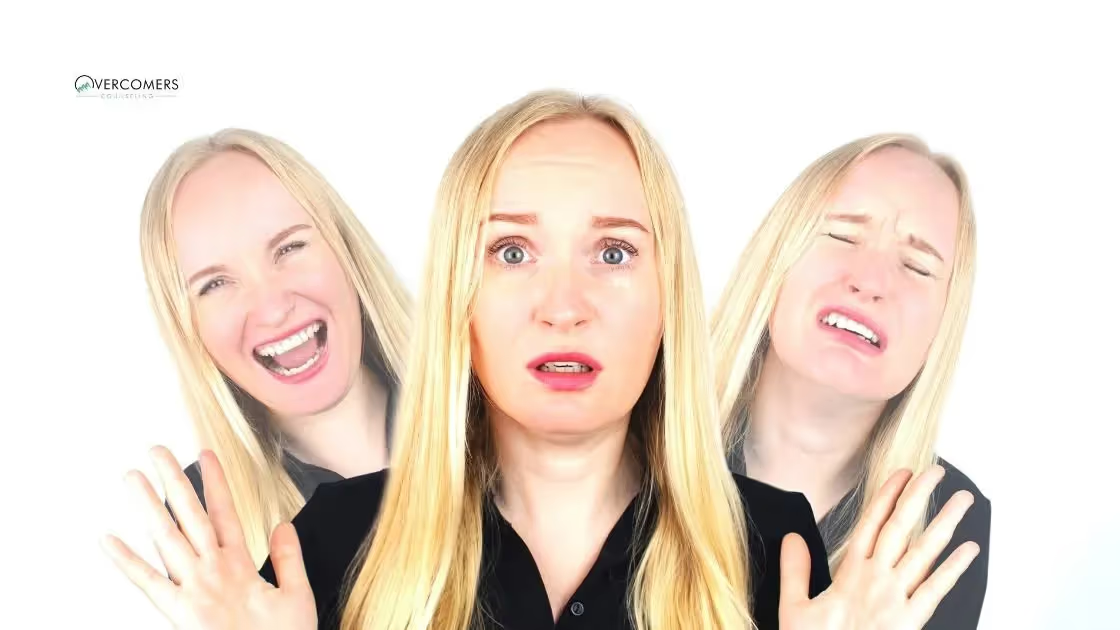
In layman's terms, bipolar affective disorder popularly known as manic depression is a mental illness that mostly affects and causes intense shifts in moods. People who suffer from this sickness witness mood swings, and changings in behavior and may often experience mania and depression. It's a disorder that mostly affects your thoughts, behaviors, etc. For instance, you might be sad this minute, and then within the next minute, you become angry. In addition, know that bipolar is not a spiritual problem as some people mistake it sometimes, but it's a mental disorder that will require you to take the right medication to be well again.
There are mostly 4 types of bipolar disorder.
Here is the list below:
This type of bipolar disorder is represented by manic episodes and can come with or without depression symptoms. For a person who has this kind of bipolar affective disorder, the manic episodes can last for a week or more though depending on how bad your case may be. And you may as well experience some kind of depression that might last for weeks.
Bipolar 2 disorder comprises both manic and depressive episodes. In this kind of bipolar affective disorder, the mania you will experience can be slightly more severe than that of bipolar 1 also known as hypomania. Then, you will experience depressive episodes either before or after you've had a manic break.
This is a kind of bipolar affective disorder, where you will experience both manic and depressive episodes for like a year or more than that. Though in this disorder, the mania and depression are usually less severe than that of bipolar 1 or bipolar 2.
In this case, you may experience symptoms that don't fit into the other 3 above bipolar types. If this is your case right now, you're considered to be a type 4 bipolar disorder "Other types" are mostly caused by alcohol, drugs, etc.

Though, the causes of bipolar affective disorder have not been scientifically proven. But then, according to researchers, it can be caused by
Below are the things they found to cause bipolar affective disorder. Genetic causes include:
Environmental causes include:
Bipolar affective disorder symptoms can sometimes be hard to deal with in your everyday life. It will have a bad effect on your work, your behavior, and your relationship with people around you. However, here are the different categories of symptoms you might experience if you have bipolar disorder: for mania symptoms.
10 symptoms of mania are as follows:
This is more like mania, but in this case, you will experience lower symptoms. For depressive symptoms.
The 6 symptoms of depression include:
This is also another symptom of bipolar affective disorder.
Its symptoms can include:
In addition, Psychotic symptoms in bipolar disorder can reveal your mood. For instance, in a situation you have a manic episode, you may believe that you have some kind of special powers whereas you don't.
The difference between these two mainly depends on the aspect of the manic episode affected by each one. It means, that a person with bipolar disorder (bipolar 1) will feel a full manic episode, whereas a person with bipolar affective disorder (bipolar 2) feels only the hypomanic episode - less serious than the latter.
Well, the bipolar affective disorder can be treated with both medical and psychological treatments.

You will be given a psychological medication that is specially designed for bipolar affective disorder. You could be given either individual or group therapy. Although, this treatment aims to help stop you from becoming unhealthy again. Hence, a talking therapist can be of help in this case. The therapist should help you to:
Bipolar affective disorder is a serious mental illness that is mostly characterized by mood changes, coupled with both mania and depression. It's a life-long and often recurring severe mental sickness that might need long-term support to help manage your condition. However, it can be controlled and managed if you see your doctor in time.
https://www.healthline.com/health/bipolar-disorder/bipolar-1-vs-bipolar-2
https://pubmed.ncbi.nlm.nih.gov/32644424/
https://cmhadurham.ca/mental-health/bipolar-affective-disorder/#:~:text=Bipolar%20means%20sharing%20two%20poles,low%20pole%20experienced%20as%20depression.
https://www.mayoclinic.org/diseases-conditions/bipolar-disorder/symptoms-causes/syc-20355955
Therapy can help with many types of depression, including major depressive disorder, persistent depressive disorder (dysthymia), seasonal affective disorder, postpartum depression, and depression related to life transitions or grief. Your therapist will tailor treatment to your specific needs.
What is the goal of depression counseling?
Living with depression can feel like walking through thick fog every day, where the world looks muted and it’s hard to find your way. The goal of counseling isn’t to instantly make the fog disappear. It’s to give you a powerful flashlight so you can find your path again. Depression counseling helps you better understand your symptoms of depression, identify what’s contributing to them, and learn healthier ways of coping.
We work together to help you understand what's behind the fog, rediscover your sense of purpose, and rebuild your life, one step at a time. We believe in your capacity to feel joy again.
How can counseling help me get my life back?
When you're dealing with depression, even the smallest tasks can feel like climbing a mountain. Counseling helps you build the skills and stamina to make that climb. Through evidence-based approaches such as cognitive behavioral therapy (CBT), we help challenge unhelpful thought patterns and behaviors that reinforce depression.
We'll help you challenge the negative thought patterns that weigh you down and find ways to re-engage with your life. Treating depression is not about perfection; it’s about progress and learning how to support yourself with compassion.
Can therapy really help with depression?
Yes! Therapy is one of the most effective ways to treat depression. Research consistently shows that depression therapy—especially CBT—is effective for depression, including major depressive disorder and persistent depressive disorder.
We'll help you navigate the difficult emotions and challenge the unhelpful beliefs that are holding you back. You are not alone in this fight, and we'll be there to support you every step of the way.
What if I don't feel motivated to go to counseling?
We get it. Depression often drains motivation, energy, and hope. A lack of motivation is itself a common symptom of depression—not a failure. You don’t have to feel “ready” to start. Just showing up is enough. We’ll meet you where you are and move at a pace that feels manageable.