If you have bipolar disorder, you're likely familiar with all the symptoms that come with it. Just for those that don't quite know what it is, let's go...

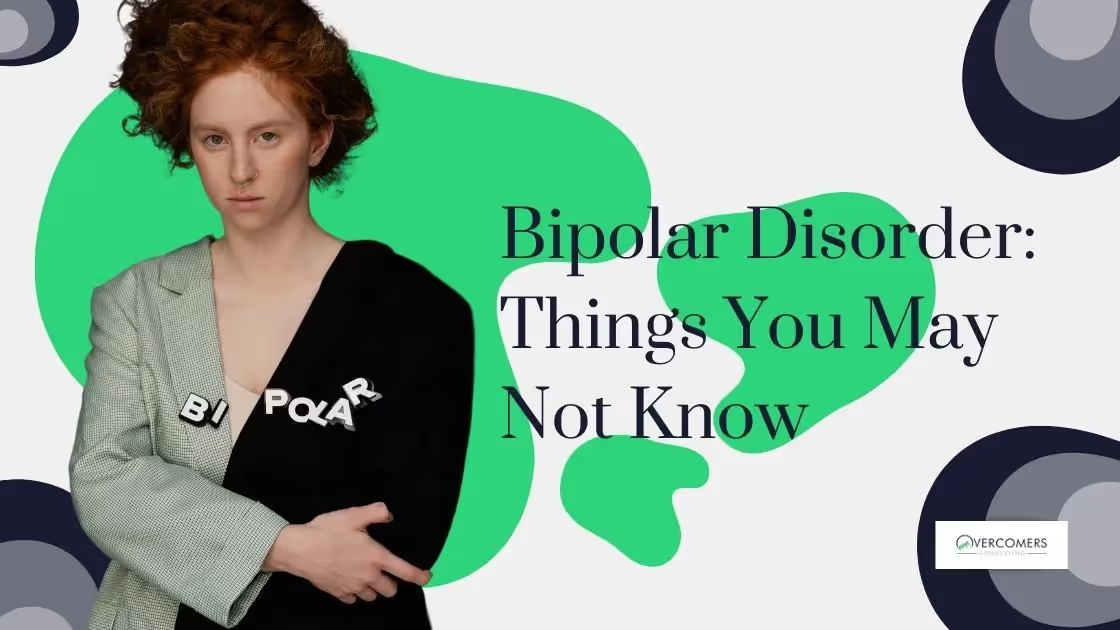
If you have bipolar disorder, you're likely familiar with all the symptoms that come with it.
Just for those that don't quite know what it is, let's go through a brief introduction.
As a mood disorder that causes intense mood swings, the challenges of this mental health issue are many.
Those that suffer from this mental illness often find their mood swings will keep them either "up" or "down" for periods of time.
Rapid cycling of moods can happen and several symptoms can present themselves when going through an episode and not in a state of neutral.
Symptoms can vary from person to person and what type of they have.
Some of the common symptoms of this disorder are having a deep sense of sadness, hypersensitivity, mood swings, lethargy, bleak outlook, and trouble sleeping.
Other symptoms include:
There are two different types of this disorder in the mental health sphere.
Bipolar I and bipolar II are both just as serious as the other, however, there are key differences between the two.
People with mood disorders rarely know which one they are until they learn of their diagnosis.
According to the American Psychiatric Association's Diagnostic and Statistical Manual of Mental Disorders (DSM-5), they define this disorder as:
"A group of brain disorders that cause extreme fluctuation in a person's mood, energy, and ability to function."
Bipolar I is a manic-depressive disorder that includes symptoms such as at least one manic episode, major depressive episodes, and hypomanic episodes.
Bipolar II doesn't have manic episodes, but they have more deep depressive episodes that last a long time.
If you have a manic episode, your psychiatrist will diagnose you with bipolar I.
There is also cyclothymic disorder, which is a type of bipolar that isn't as well known.
The DSM-5 defines this as "a cyclic disorder that causes brief episodes of hypomania and depression."
This disorder usually results in less extreme cycles of hypomania and depression but is just as serious a type of mental health disorder.
Bipolar is..."A group of brain disorders that cause extreme fluctuation in a person's mood, energy, and ability to function."
American Psychiatric Association's Diagnostic and Statistical Manual of Mental Disorders
Anxiety is another big factor that comes into play.
Often those that have this disorder also have some comorbidities, too.
All too often, these are symptoms such as anxiety, poor self-esteem or even other mental illness and health conditions.
This mood disorder also only affects 2.5% of the population, and it has its own chapter in the DSM-5 because of its severity.
The issue is that most people usually come from a family background where someone has it, too.
Learning more about your family history is important to improve your likelihood of successful treatment.

As a mental health patient, or a friend of one, you'll want to be educated and learn the ins and outs of your relationship with your mental health.
Research and self-care are two important things you can do for yourself when you have this disorder.
Living with bipolar is difficult for those that have it.
Treatment comes in many forms, from medications to therapy.
Mental health therapists are there to help overcome these obstacles, and you should reach out to one if you're experiencing these symptoms.
Talk to a family member or reach out to those around you should you need help.
As a mental health patient or a friend of one, you'll want to be educated and learn the ins and outs of your relationship with your mental health.
Research and self-care are two important things you can do for yourself when you have this disorder.
Living with bipolar is difficult for those that have it, but treatment comes in many forms, from medications to therapy.
Mental health therapists are there to help overcome these obstacles, and you should reach out to one if you're experiencing these symptoms.
Talk to a family member or reach out to those around you should you need help.
https://www.psycom.net/bipolar-definition-dsm-5/
https://www.healthline.com/health/bipolar-disorder
https://medlineplus.gov/bipolardisorder.html
Therapy can help with many types of depression, including major depressive disorder, persistent depressive disorder (dysthymia), seasonal affective disorder, postpartum depression, and depression related to life transitions or grief. Your therapist will tailor treatment to your specific needs.
What is the goal of depression counseling?
Living with depression can feel like walking through thick fog every day, where the world looks muted and it’s hard to find your way. The goal of counseling isn’t to instantly make the fog disappear. It’s to give you a powerful flashlight so you can find your path again. Depression counseling helps you better understand your symptoms of depression, identify what’s contributing to them, and learn healthier ways of coping.
We work together to help you understand what's behind the fog, rediscover your sense of purpose, and rebuild your life, one step at a time. We believe in your capacity to feel joy again.
How can counseling help me get my life back?
When you're dealing with depression, even the smallest tasks can feel like climbing a mountain. Counseling helps you build the skills and stamina to make that climb. Through evidence-based approaches such as cognitive behavioral therapy (CBT), we help challenge unhelpful thought patterns and behaviors that reinforce depression.
We'll help you challenge the negative thought patterns that weigh you down and find ways to re-engage with your life. Treating depression is not about perfection; it’s about progress and learning how to support yourself with compassion.
Can therapy really help with depression?
Yes! Therapy is one of the most effective ways to treat depression. Research consistently shows that depression therapy—especially CBT—is effective for depression, including major depressive disorder and persistent depressive disorder.
We'll help you navigate the difficult emotions and challenge the unhelpful beliefs that are holding you back. You are not alone in this fight, and we'll be there to support you every step of the way.
What if I don't feel motivated to go to counseling?
We get it. Depression often drains motivation, energy, and hope. A lack of motivation is itself a common symptom of depression—not a failure. You don’t have to feel “ready” to start. Just showing up is enough. We’ll meet you where you are and move at a pace that feels manageable.