
What adult ADHD counseling actually involves, what it costs, and how to find a Colorado therapist who takes your insurance.


Adult ADHD counseling usually combines talk therapy — most often cognitive behavioral therapy — with hands-on strategies for focus, time management, and the emotional weight that comes from years of feeling like you're falling behind. It's not just something kids grow out of. Whether you were diagnosed at seven or you're only now connecting the dots at thirty-five, counseling can help you build a life that works with your brain instead of against it.
Maybe you've always been the one running ten minutes behind, no matter how early you set your alarm. Maybe your inbox has forty unread emails you meant to answer weeks ago, and the guilt of that pile has started to feel bigger than the emails themselves. Maybe you've quietly wondered, more than once, why everyone else seems to manage their life without this much effort.
That doesn't mean you're doing anything wrong. It might mean your brain works differently than the systems — school, work, your own to-do list — were built to expect.
ADHD in adults is a well-documented neurodevelopmental condition, not a character flaw or a motivation problem. According to CHADD, the national ADHD advocacy organization, roughly 15.5 million adults in the U.S. have been diagnosed with ADHD, and it often shows up alongside difficulty at work, strained relationships, and a running undercurrent of frustration or guilt. Many adults aren't diagnosed until later in life, after years of assuming their struggles were personal failings instead of a wiring difference.
Cognitive behavioral therapy. CBT is the most researched talk therapy for adult ADHD, and it's less about "trying harder" and more about identifying the specific thought patterns and habits that make daily life harder than it needs to be, then replacing them with systems that actually stick. Mayo Clinic notes that psychotherapy tends to work best paired with medication management rather than used as a stand-alone fix, though the right combination is different for everyone.
Skills-based work within therapy. Building routines, breaking tasks into steps that don't feel overwhelming, and creating external structure for a brain that doesn't generate its own rounds out the clinical work. ADDA, the Attention Deficit Disorder Association, notes that different approaches suit different goals — someone working on relationships may lean into interpersonal-focused therapy, while someone working on emotional regulation may benefit more from a mindfulness-based approach.
Coordination with medication management, when it's part of the picture, means your therapist and prescriber are working from the same page instead of you having to translate between two separate providers.
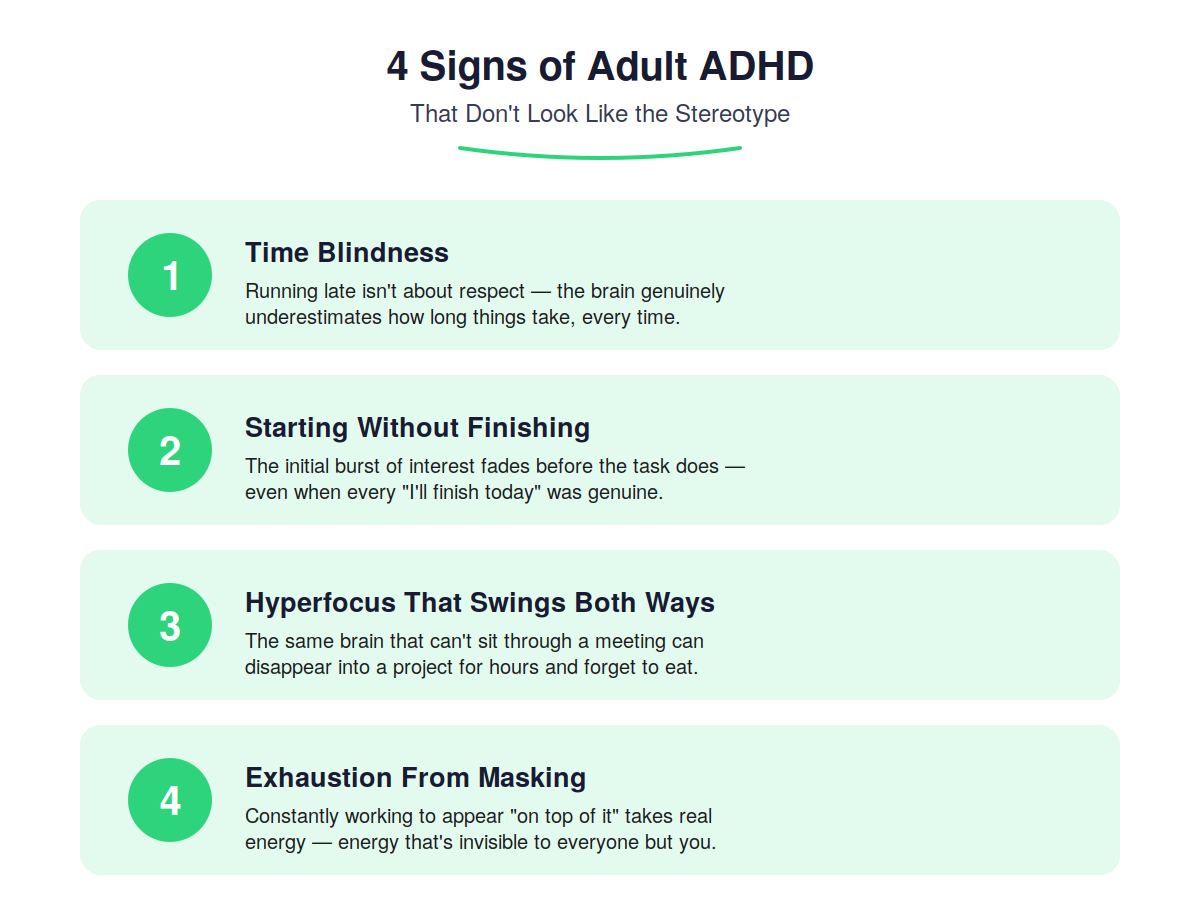
Time blindness that has nothing to do with caring. You're not late because you don't respect people's time — your brain genuinely underestimates how long things take, every time.
Starting five things and finishing none of them. The initial burst of interest fades before the task does, even when you meant every word of "I'll finish this today."
Hyperfocus that swings the other way. The same brain that can't sit through a status meeting can disappear into a project for six hours and forget to eat.
Exhaustion from masking. A lot of adults with ADHD spend enormous energy just appearing "on top of it," and that effort is invisible to everyone but you.
Our providers use evidence-informed approaches, including CBT, to help you understand your ADHD instead of just white-knuckling through it. That means building routines that actually hold up under real life, working through the years of self-criticism that often come with a late diagnosis, and coordinating with our psychiatry and medication management team when that's part of your plan. For clients who want it, we also offer faith-integrated counseling.
Answering the email the same week you got it, not three weeks later with an apology attached. Trusting your own calendar instead of triple-checking it out of fear you missed something. Finishing the project without the guilt of everything else you didn't get to.
Cost is often the real question underneath "where do I even start," and it deserves a straight answer. Overcomers Counseling accepts Medicaid (Health First Colorado) and most major insurance plans, including Aetna, Cigna, UHC, Kaiser, Anthem BCBS, and Tricare, so coverage isn't something you have to guess at before you reach out. You can read more about how we work with Health First Colorado coverage here. Our team verifies your benefits and handles the paperwork before your first appointment, so cost isn't one more thing standing between you and getting started.
Find an ADHD-informed therapist in Colorado Springs, Aurora, Fort Collins, or Pueblo, or connect through secure teletherapy from anywhere in Colorado. You don't need a childhood diagnosis or a formal evaluation in hand to start — if focus, follow-through, or the mental exhaustion of keeping it together is wearing you down, that's reason enough to reach out.
However long you've been managing this on your own, reaching out now is a sign of strength, not a last resort. Get matched with a therapist today.
Untreated ADHD in women can lead to low self-esteem, mood swings, and difficulty focusing. It can also increase the risk of eating disorders, substance abuse, and other mental health issues.
Women with high functioning ADHD may appear to manage their symptoms well but still struggle internally. They may have successful careers but struggle with time management, organization, and maintaining social relationships.
Inattentive type ADHD is characterized by difficulty paying attention, forgetfulness, and disorganization. Women with this type of ADHD may struggle with completing tasks, following instructions, and maintaining focus.
While not listed as a core symptom in the Diagnostic and Statistical Manual, research suggests that emotional dysregulation is a common and impactful aspect of ADHD.
Yes, both children and adults with ADHD can experience emotional dysregulation. However, the manifestations may differ, with adults often having more complex processes and coping mechanisms.
While not listed as a core symptom in the Diagnostic and Statistical Manual, research suggests that emotional dysregulation is a common and impactful aspect of ADHD.
No. We DO offer counseling (talk therapy) or medication management for individuals with ADHD or ADHD type symptoms. If you are looking for a formal evaluation involving extensive testing, you will need to seek a Psychologist.
Yes, online therapy can be just as effective as in-person counseling for ADHD. Many adults prefer virtual sessions because they reduce stress, save time, and allow for more consistency—especially if staying organized and on schedule is a challenge.
Yes. ADHD can affect communication, emotional regulation, and follow-through, which can strain relationships. An ADHD counselor can help you develop skills to improve communication, manage conflicts, and build healthier relationship dynamics.
Absolutely. Many adults seek an ADHD therapist specifically to improve executive functioning skills like time management, task initiation, prioritizing, and reducing procrastination. Therapy can help you build systems that support sustained success at work.
ADHD: the brain’s way of saying “too many tabs open.” It’s a neurodevelopmental condition that makes focusing tricky, impulsivity inevitable, and hyperactivity a constant. Many adults don’t even realize they have it, but untreated ADHD can mess with emotional balance, self-esteem, and big life changes like new jobs.
The good news? With the right treatment, you can close a few tabs and regain control.