A question I am frequently asked by clients is "what does 'Jungian' mean?" quickly followed by, "did I say that right?" The answer to the second question...

A question I am frequently asked by clients is "what does 'Jungian' mean?" quickly followed by, "did I say that right?"
The answer to the second question is much easier, so I'll start there and then expand on the first.
Pronounced Young-ian (or Yoon-gi-an), Jungian Analysis was developed by the famous Swiss psychoanalyst Carl Jung (pronounced Carl Young) and involves using religious stories, mythology, symbolism, and dreams as a means of bringing unconscious motivations/desires/fears to the surface.
Jung believed that by identifying deeply rooted motivations and fears in the unconscious, a person could then integrate what was useful and discard what was no longer necessary; thus breaking the shackles (so to speak) of depression and anxiety.
If this sounds esoteric and ethereal to you, you are not alone, but it may be more tangible than it looks.
So, to bring these ideas down to earth, perhaps the next question to ask is, what are the basics of Jungian Analysis?
Two fundamental aspects of Jungian Analysis are Dreams and Archetypes.
We are all familiar with what dreams are, but how can we use them? Jung believed that dreams reflected concerns about the past, worries about the future, and conflict within the individual. Perhaps you've had a dream like a giant taco was delivered by aliens and you are now thinking, "what possible meaning could that have!?"
Healthy skepticism is always appreciated, but recent studies have shown that 70% percent of individuals who participated in a dream study believed they found answers to looming, anxiety-provoking questions simply by taking time to write about their dreams.
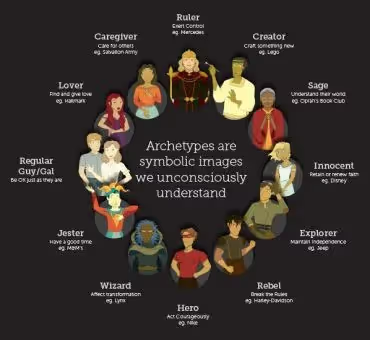
Our minds use whatever images are most readily available but are operating on the basis of what Jung called the Archetypes.
To use the example above, a taco may be the most readily-available image, but it could be connecting to the Archetype of nourishment, the feeling of joy, or any number of things relevant to the individual.
But what exactly are Archetypes?

Archetypes can be thought of as the blueprints of certain recurring ideas, images, and roles found throughout stories and myths from the earliest written and oral traditions.
Examples include the Hero, the Wise Old Man or Woman, the Nurturing Mother, the Witch, the Tyrant King, etc.
A quick look at how successful the Marvel movie franchise has been will demonstrate just how popular and relevant these archetypes truly are (grossing over $25 billion worldwide, and counting).
With a little bit of effort, we can identify countless archetypes in our own lives, as well as in our dreams, and we can begin connecting those archetypes to our daily lives. After all, who wouldn't want to truly feel like the hero of their own life?
The reality is, we are, and just like in the Marvel movies, the hero must always face terrible dangers.
And it is in this way that archetypes are relevant to us.
We may not have to literally fight off super-villains, but what an incredible way to view our own trials and struggles- as a fight to save the world, your world, your life, as often is the case.
A third essential aspect of Jungian Analysis is the Shadow, Persona, and Self. These three comprise an individual's personality.
The Shadow represents the aspects of a person that the individual wants to keep hidden from others (and themselves), either because they are ashamed of it, or society says to feel ashamed of it.
It is the "dark side" of our thoughts, feelings, and actions that we disown and, unfortunately, project outward.
The persona, on the other hand, is the other end of the teeter-totter; it is the way we want others to see us, the mask we wear.
Often the persona is used to protect us, shield us from ridicule, and therefore is not our authentic self.
The positive side of the persona is that it may represent who we would like to become.
Lastly, the Self. This is the authentic you.
Who you are when no one is looking, or better yet when you are with the people you feel most comfortable and relaxed with.
It is the unification of the conscious and unconscious; the integration of the shadow and the removal of the persona.
Actualizing this Self is what Jung called the process of Individuation, and can be thought of as the ultimate goal of every individual.
Utilizing the basics of Jungian Analysis- dreams, archetypes, shadow, persona, and self- you can gain insight into your unconscious motivations and fears and finally rid yourself of what is unnecessary and fully integrate what is essential.
However imaginative, creative, religious, or story-oriented you are, Jungian Analysis provides a deeper way to view the mundane; a way to foster a re-connection to being human and to the generations of humankind that led to you being here today.
Access your unconscious, become the hero of your story, live with fulfillment and meaning.
Other activities which have been found helpful in reducing both immediate feelings of anxiousness and long-term anxieties associated with chronic disorders include yoga, journaling, nature walks, art therapy, volunteering, and other low-stress activities. Additionally, developing a healthy lifestyle incorporating adequate sleep, physical activity, and nutritious meals can help reduce overall stress levels.
Yes, Medicaid provides insurance coverage for therapy services specifically designed to help individuals struggling with anxiety, depression, and other mental health conditions.
We all get a little anxious sometimes—like a sudden jolt of nerves before a big presentation or a first date. But if that nervous feeling has become a constant companion, like an uninvited roommate that won’t leave, it might be time for counseling. Signs that it's more than a passing worry include persistent fear, difficulty sleeping, or avoiding situations that trigger your anxiety. We understand how exhausting this can be. We can work together to help you get your living space back.
Think of anxiety counseling as your personal guide to untangling a complicated knot of thoughts and fears. While it may feel impossible right now, you have the power to conquer it. We'll give you a toolkit of strategies, from understanding what's triggering your worry to practicing deep breathing exercises that calm your nervous system. Through counseling, you'll learn to recognize your thought patterns and challenge them, so you can stop being a passenger in your own life and start being the one in the driver’s seat.
The most effective approach to treating anxiety is like finding the perfect pair of shoes—what works for one person might not work for another. However, a common and effective therapy is Cognitive Behavioral Therapy (CBT). It helps you identify negative thought patterns and behaviors that feed your anxiety. We also use other approaches, like exposure therapy, to help you gradually face your fears in a safe and supportive way. We'll help you find the right fit for your unique needs.