The short answer is yes, Anxiety can be genetic. Specifically, it is a trait which is heritable, or genetically transmitted from one generation to the...


The short answer is yes, Anxiety can be genetic. Specifically, it is a trait which is heritable, or genetically transmitted from one generation to the next.
Anxiety is part of the normal range of human emotion, which we have all experienced.
Anxiety is a useful emotion as it lends to motivations.
People who are anxious are highly attuned to threats in their immediate surroundings, or their possible future.
Anxiety has to cross certain thresholds in terms of severity, frequency of occurrence, and endurance before it is a diagnosable psychiatric disorder.
When anxiety levels escalate to a level where acute distress and impairment of functioning occurs, it is a problem. If this occurs regularly, and for an extended period of time, it can be diagnosed as an anxiety disorder.
Meta- anxiety is anxiety about anxiety.
I have anxiety, will my children have it too is the question parents wonder about. The answer is maybe. Another answer is there are things you can do about it.
We are not confined by our genetics. The notion that we are is called biological reductionism. Human beings are more complicated than this. While we are definitely heavily influenced by our genetics, we are also heavily influenced by our environment. Nature vs nurture, or genetics vs environment is an old debate. The debate has more or less reached a place where the two influences are not seen dichotomously and in opposition, but as complementary (Kwong, et al, 2019).
The role of free will must also be considered. An anxious parent may pass their anxiety genes to their children. The environment in which the child is raised will either attenuate or exacerbate anxiety.
Our genetics is a broad, general term to refer to characteristics and traits we are born with. These are physical features that are ours, whether we want them or not. This includes our eye color, hair color, eventual adult height, and predisposition toward certain diseases. Our genetics are often referred to as a roll of the dice.
It is beyond our control, and we have to live with what we get. There is evidence that anxiety is carried by six genes, which are also associated with depression (Gottschalk, et al,2017, and Yale University, 2020,).
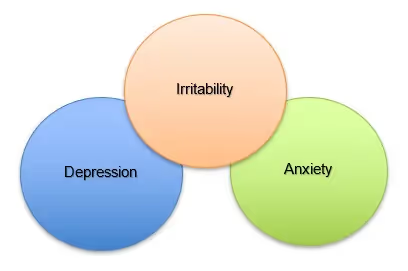
Depression and anxiety frequently occur together. Another element is irritability (Grohol, 2018). It has been long established that depression in adolescents is expressed as irritability. Men who are depressed are also more likely to be angry, while depressed women are more likely to be tearful. Neurologically, it makes sense that anxiety, depression, and irritability are all interconnected.
The amygdala is a part of the limbic system in the brain. The amygdala is the control center for fear and anger. Both emotions are integral to survival, and part of the Fight/Flight/Freeze system. Fear motivates us to flee or withdraw from a threat. Anger motivates us to engage the threat.
Environment
Our environment influences, shapes, molds, and some people say, determines our behaviors. The environment has a role in disease. Children learn by modeling. They observe their parents, siblings, and peers, and emulate their behavior, for better or worse. The parent who models calm can have both an immediate soothing and comforting effect on their child, and also demonstrate to their child how to act under stress.
An anxious parent modeling anxious responses to stimuli can influence their child's reactions. (Selbing, & Olsson, 2019). Over time, this can make for an anxious child. Children who grow up in the company of anxious parents can learn to respond to stress with anxiety. Modeling calm for your children can make a difference. Growing up in a stressful environment or experiencing trauma as a child can produce anxiety disorders, typically PTSD (Post-traumatic Stress Disorder).If a child is already genetically predisposed toward anxiety, this can create increase the probability of developing a disorder. Collectively, childhood stressors are referred to as ACE (Adverse Childhood Experiences).
This can include:
There are grim long term findings for children who have experienced ACE. There is a greater incidence of mental illness, addiction, incarceration, heart disease, diabetes, cancer, serious accidental injury, and premature death Felitti, V.J., et al, 1998). While this information is daunting, it is important to recognize that this is about increased risk, not certainty. Here is where environment, genetic and free will all work in concert.
If you had ACE, and a family history of cancer, you are not doomed to get cancer for certain. You are at increased risk. Your free will can make a difference. If you choose to start smoking. You will elevate your risk even further. If you have a family history of heart disease, and choose to do cardiovascular exercise and eat healthy, and choose not to start smoking, or to quit, you will reduce your risk of heart disease.
Free will
Our choices and decision-making processes are also an important factor in the disease. The daily choices we make can either increase or decrease our risk. In this way, the role of free will can attenuate anxiety. The choice to seek treatment is another important decision. There are highly effective treatments available for anxiety disorders.
Genetics, environment, and free will all work together to make us who we are. They can align or misalign.
There are many subfactors within each of these three areas which will produce individual outcomes. If your parents had problems with anxiety, or you are a parent concerned about your children, it does not guarantee you will develop an anxiety disorder, or pass it on.
Felitti, V.J., Fanda, R., Nordenberg, D., Williamson, D.F., Spitz, A.M., Edwards, V., Koss, MP, Marks, J. (1998). Relationship of Childhood Abuse and Household Dysfunction to Many of the Leading Causes of Death in Adults: The Adverse Childhood Experiences (ACE) Study. American Journal of Preventive Medicine. 14, (4), 245-258. https://doi.org/10.1016/S0749-3797(98)00017-8
Gottschalk, Michael & Domschke, Katharina. (2017). Genetics of generalized anxiety disorder and related traits. Dialogues in Clinical Neuroscience. 19. 159-168.
Grohol, J.M. (2018). Why So Angry & Irritable? It Might Be Depression. PsychCentral. Retrieved April 14, 2020 from: https://psychcentral.com/blog/why-so-angry-irritable-it-might-be-depression/
Kwong ASF, López-López JA, Hammerton G, et al. (2019). Genetic and Environmental Risk Factors Associated With Trajectories of Depression Symptoms From Adolescence to Young Adulthood. JAMA Network Open. 2(6):e196587. doi:10.1001/jamanetworkopen.2019.6587
Selbing, I. and Olsson, A. (2019). Anxious behavior in a demonstrator affects observational learning. Retrieved April 11, 2020 from https://www.nature.com/articles/s41598-019-45613-1
Yale University. (2020, January 7). Study of veterans details genetic basis for anxiety, links anxiety and depression. ScienceDaily. Retrieved April 11, 2020 from www.sciencedaily.com/releases/2020/01/200107081248.htm
Other activities which have been found helpful in reducing both immediate feelings of anxiousness and long-term anxieties associated with chronic disorders include yoga, journaling, nature walks, art therapy, volunteering, and other low-stress activities. Additionally, developing a healthy lifestyle incorporating adequate sleep, physical activity, and nutritious meals can help reduce overall stress levels.
Yes, Medicaid provides insurance coverage for therapy services specifically designed to help individuals struggling with anxiety, depression, and other mental health conditions.
We all get a little anxious sometimes—like a sudden jolt of nerves before a big presentation or a first date. But if that nervous feeling has become a constant companion, like an uninvited roommate that won’t leave, it might be time for counseling. Signs that it's more than a passing worry include persistent fear, difficulty sleeping, or avoiding situations that trigger your anxiety. We understand how exhausting this can be. We can work together to help you get your living space back.
Think of anxiety counseling as your personal guide to untangling a complicated knot of thoughts and fears. While it may feel impossible right now, you have the power to conquer it. We'll give you a toolkit of strategies, from understanding what's triggering your worry to practicing deep breathing exercises that calm your nervous system. Through counseling, you'll learn to recognize your thought patterns and challenge them, so you can stop being a passenger in your own life and start being the one in the driver’s seat.
The most effective approach to treating anxiety is like finding the perfect pair of shoes—what works for one person might not work for another. However, a common and effective therapy is Cognitive Behavioral Therapy (CBT). It helps you identify negative thought patterns and behaviors that feed your anxiety. We also use other approaches, like exposure therapy, to help you gradually face your fears in a safe and supportive way. We'll help you find the right fit for your unique needs.