Anxiety can range anywhere from a steady annoyance to a debilitating fear.It causes physical distress that can cause health issues ranging from digestive...

.avif)
Anxiety can range anywhere from a steady annoyance to a debilitating fear.
It causes physical distress that can cause health issues ranging from digestive issues, muscle tension, headaches, and fatigue to increased risk of heart disease and degenerative brain disease.
Everybody deals with anxiety on some level, but how do you prevent anxiety not only from robbing you of life experiences but from causing serious health concerns?
Is there a way to eliminate anxiety as a whole?
These are all questions that will be answered today.
But first, I want you to take a moment to imagine how much better your life could be if you didn't struggle with anxiety.
What opportunities and experiences would you pursue and capitalize on?
How much easier would your life be if you could go to the grocery store, or run errands without constant worry and a racing heart?
Connecting your mind to concrete improvements in your life will help you make the changes you need and improve your motivation.
The idea of no anxiety is nice, but once you put it into concrete terms and make it specific to your daily life, then it becomes a goal instead of just a fantasy.
Now let's look at what anxiety is, how it can create health issues, and what can be done about it.
Let's work out anxiety.
If we really want to work out anxiety it's important to know what it is and how it creates health issues.
For most people, anxiety is relatively low and specific to instances where they are subject to embarrassment in front of others.
For others, however, anxiety can be far more intense and occur much more frequently, sometimes without apparent cause.
Regardless of the degree you experience anxiety, it all starts in the amygdala.
The amygdala is a very old part of the brain and one of the first parts of the brain to develop.
What does the amygdala trigger?
Fear.
The amygdala is our built-in alarm system that shoots fear signals for any threat, real or imagined, immediate or potential.
So, to work out anxiety is to understand how fear works in the brain.
Some fears seem to be automatic while others are conditioned; such as being near the edge of a cliff versus your older sibling scaring you with a frog during early childhood.
So, anxiety is the body's response to a fear impulse initiated by the amygdala to an actual or imagined threat.
How does that lead to health issues?
Sure, it's uncomfortable at the moment, but heart disease? Brain disease? Really?
How do we work out anxiety in those extreme cases?
This is where stress enters the conversation when we try to work out anxiety and its effects.
The increased heart rate, muscle tension, rapid breathing, sweating, and everything else you experience when you are anxious is the stress response from our autonomic nervous systems.
In other words, that is exactly what our body is supposed to do when stressed out.
It turns on certain functions in the body and turns off other functions so that we can survive the stressful encounter; this is called fight or flight.
The problem with highly anxious individuals is that the stress response system actually triggers a secondary fear response from the amygdala which pours more adrenaline into the body making the reaction even more stressful.
In addition, if a person is constantly anxious then their stress response is constantly activated and they enter into what's known as chronic stress.
Chronic stress is what creates inflammation and causes digestive issues, heart disease, brain disease, and most other chronic health issues.
Again, for most people, anxiety does not extend into these deeper reaches, but anxiety gone unchecked can lead to many health-related issues on top of the impairment it causes by itself.
Okay, we've been able to work out anxiety in terms of what it is and how it can impact many dimensions of health, can we work out anxiety in terms of treatment and potentially even eliminate it?
Here's the good news.
You can work out the anxiety.
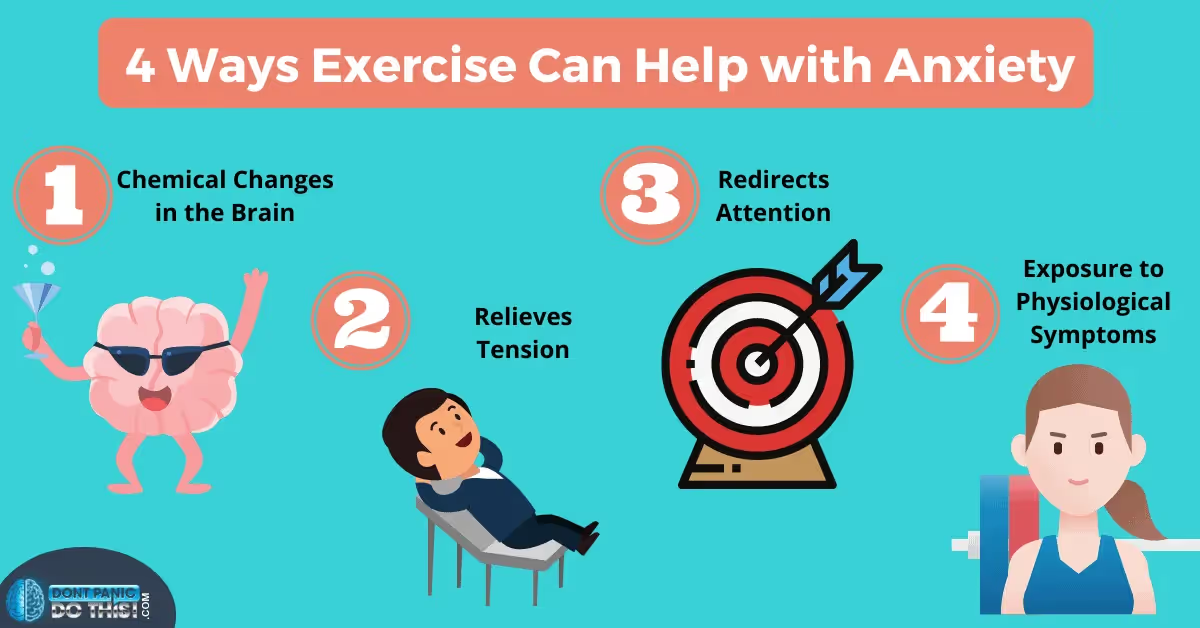
Through physical exercise, you can literally and metaphorically work out the anxiety.
As it turns out, the stress response we discussed earlier can be activated through physical exercise.
Everything your body does when exercising is the same it is what happens when you feel anxious, and your mind does not differentiate between physical and mental stressors.
By consciously engaging in physical exercise, you are teaching your mind and body that stress isn't a bad thing.
This simultaneously reduces your anxiety and increases your resiliency to anxiety and stress.
You can start small too.
20-minute walks significantly reduce feelings of anxiety.
Add in an intense burst of effort for 20-30 seconds and you're on a great track to eliminate unnecessary anxiety.
Gradually work your way up to HIIT training exercises 3 times a week and you'll be amazed at how different you'll feel.
One study showed that in 3-months of HIIT training, 3 times per week, reduced overall anxiety by 40%.
That's almost half!
Imagine how much better your life would be if you had nearly half the anxiety you currently have.
And, it continues to decrease over time; the more effort you put in, the less anxiety you have.
Anxiety is experienced by everyone on the planet, but it doesn't have to be a limiting factor to your enjoyment of life.
Your mind can't tell the difference between physical and mental stress and responds the same to both.
This opens to door to allow you to work out anxiety by literally working out.
This is one of the greatest discoveries in treating anxiety because it allows you to circumvent specific anxiety-provoking situations and allows you to reduce anxiety as a whole.
Start off slow by taking daily walks.
Then integrate short bursts of high intensity like sprinting for 20-30 seconds.
Then do that 2-3 times per walk, then 2-3 times per week.
The more work you put in, the less anxious you'll begin to feel.
Take your life back, and work out the anxiety.
Other activities which have been found helpful in reducing both immediate feelings of anxiousness and long-term anxieties associated with chronic disorders include yoga, journaling, nature walks, art therapy, volunteering, and other low-stress activities. Additionally, developing a healthy lifestyle incorporating adequate sleep, physical activity, and nutritious meals can help reduce overall stress levels.
Yes, Medicaid provides insurance coverage for therapy services specifically designed to help individuals struggling with anxiety, depression, and other mental health conditions.
We all get a little anxious sometimes—like a sudden jolt of nerves before a big presentation or a first date. But if that nervous feeling has become a constant companion, like an uninvited roommate that won’t leave, it might be time for counseling. Signs that it's more than a passing worry include persistent fear, difficulty sleeping, or avoiding situations that trigger your anxiety. We understand how exhausting this can be. We can work together to help you get your living space back.
Think of anxiety counseling as your personal guide to untangling a complicated knot of thoughts and fears. While it may feel impossible right now, you have the power to conquer it. We'll give you a toolkit of strategies, from understanding what's triggering your worry to practicing deep breathing exercises that calm your nervous system. Through counseling, you'll learn to recognize your thought patterns and challenge them, so you can stop being a passenger in your own life and start being the one in the driver’s seat.
The most effective approach to treating anxiety is like finding the perfect pair of shoes—what works for one person might not work for another. However, a common and effective therapy is Cognitive Behavioral Therapy (CBT). It helps you identify negative thought patterns and behaviors that feed your anxiety. We also use other approaches, like exposure therapy, to help you gradually face your fears in a safe and supportive way. We'll help you find the right fit for your unique needs.