Our journey towards mental well-being and health often draws us toward inner reflection. These reflections could be about healthy and unhealthy behaviors,...


Our journey towards mental well-being and health often draws us toward inner reflection.
These reflections could be about healthy and unhealthy behaviors, people, and places in our lives.
Especially if we have gone through rough experiences and trauma, we become more susceptible to feeling unsafe constantly.
Be it our mind or body, it feels like there's a constant race going on, and our thoughts are winning.
Helping our mind and body feel safe requires a safe space for ourselves, whether it is somewhere outside or within us.
"I SURVIVEDBECAUSETHE FIREINSIDE MEBURNEDBRIGHTERTHAN THE FIREAROUND ME."
Whether internally or externally, a safe space helps you have a place you can reach out for when the going gets tough and fighting seems exhausting.
A safe space helps us process all of our emotions without feeling judged and become a higher version of ourselves.
It lets us come out of combat mode, put our shield down, and truly experience ourselves as a person with our ordinary sufferings.It becomes a tool that shall guide you and center yourself amid adversity.There are many ways to find this safe space for ourselves.
Without a doubt, Therapy is always a safe space for us to process our emotions.
It also gives us a clue on how to hold that space for ourselves.
Therapy provides one with the tools to address our victories, failures, difficulties, and traumas.
Having a person sit with us and experience us in the way we are, whether messy, put-together, or differentiated, at different times, lets us genuinely believe that we can also hold that space for ourselves.When we come with our baggage and put ourselves out there, we learn that vulnerability is not all that bad.
We also understand that if there is a person who can experience us safely, we too can experience ourselves safely and without judgment.You shall lead the treatment as you work with your therapist.
Therapy is not one-size-fits-all, and you can choose to find a therapist who works with an approach you find comfortable.
People who have gone through similar struggles make us realize that we are not alone.
Moreover, you may have noticed that if someone comes up to you with a similar problem, you tend to have more compassion for them.
However, if you were experiencing a similar situation, you may not be as kind to yourself.
When we experience ourselves, we often do so with judgment.
When we experience others, we often do so with a little more compassion.Support Groups also give you an insight into how other people create a safe space for themselves.
Unique challenges require unique solutions, and who better to provide you with one than someone who knows what you're going through?
Moreover, having a community gives a holding space for you until you have an inner safe space worked out for yourself.
While others help us learn about creative solutions for finding a safe space, allow yourself to create an inner space within yourself.Our lives are filled with the hustle and bustle, and with advanced technology, there are no stimuli that are not available to us.
However, we forget to get in touch with our own being in all of that.Begin small: in those few moments of waiting in a line, or in the subway, instead of engaging on your phone, decide to simply "be."
Intentionally not doing anything at that moment helps us become more in tune with ourselves and our surroundings.Although the above sounds close to a meditative practice, the idea is to allow yourself to experience yourself as someone who "just is" instead of always "doing" something.
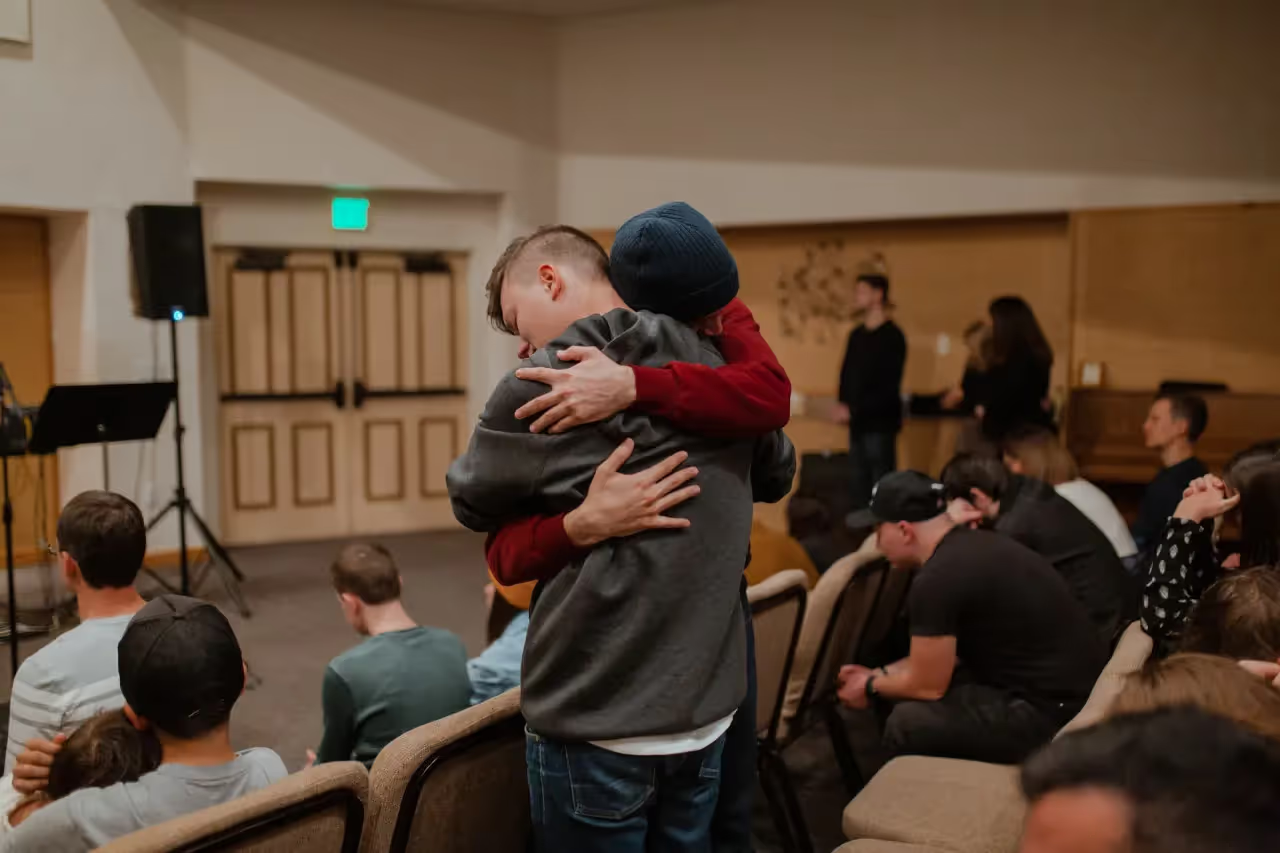
Sometimes, we have safe spaces that are not readily accessible to us.
People talk about how their safe space is a memory from the past, a place from their childhood, etc.
In such a scenario, visualization or guided imagery can help you access those spaces in your internal world, ground yourself, and experience the calmness you need to move forward.
A few simple steps that you can follow for doing visualization on yourself are:
If this is difficult for you to do alone, you can always seek resources online, for instance, a video on guided imagery on YouTube.
However, it is advisable to go to a trusted and safe professional if you are not yet sure if you can hold that safe space for yourself.
The journey toward finding your inner safe space can be daunting.
You may face uncertainty, pain, and past traumas coming up.For people who have PTSD or Complex Trauma, some of these techniques may work with long-term therapeutic work or not work as well.The method or way of finding your inner space is unique to you, and as long as you stay safe in your journey, all that matters is what you need.
Safe spaces develop both internally and externally.
It can happen in and through Therapy, with the help of support groups, and through a few self-reflecting exercises.Finding a safe space is hard work.
Sometimes it can be draining.
Sometimes we grow out of those places, and sometimes we find new places.
However, the idea behind finding this safe space is to evolve and nurture the self.
What is the goal of trauma counseling?
Trauma can feel like you're carrying a heavy, invisible backpack full of painful memories. It's exhausting, and it can be difficult to move forward. The goal of counseling isn't to get rid of the backpack immediately. It's to help you gently unpack it, one item at a time, so you can feel lighter and more confident. Trauma counseling focuses on helping you safely process traumatic experiences, reduce distressing symptoms, and regain a sense of control over your life.
We believe you have the power to live a life that is full and rewarding, and we are here to help you get there.
How can a counselor help me with my trauma?
Trauma can feel like you're in a movie with a strange script and a set of rules that no one else can see. Counseling helps you find your footing in a world that can feel confusing and overwhelming. A therapist specializing in trauma is trained to help you understand how trauma affects the brain and body, including symptoms related to post-traumatic stress disorder (PTSD).
We work together to help you understand your thoughts and feelings, build a sense of self, and find a sense of peace and security. Trauma therapy may also support healing related to grief, loss, and therapy for grief and trauma that overlap after painful life events.
What are some common signs of trauma?
Trauma is a deeply personal journey, and there’s no right or wrong way to feel. It's a bit like a fingerprint—it's unique to you. You may feel a mix of sadness, anger, guilt, emotional numbness, or even fear. Other signs may include hypervigilance, difficulty sleeping, intrusive memories, avoidance, or feeling disconnected from others—especially after traumatic events.
We want you to know that whatever you're feeling is valid. We provide a safe, non-judgmental space for you to process your emotions. You are not alone in this, and we're here to help you every step of the way.
How do I begin to heal from my trauma?
Healing from trauma can feel like trying to fix a broken bone without a cast—it’s difficult and painful without the right support. We want to be your support. The healing process often begins by recognizing that what you experienced was overwhelming and that your reactions make sense.
We'll work with you to process the past trauma and find new ways to cope with the stress and fear. With the right trauma therapist and mental health care, healing is possible—even after complex trauma.